
Tuesday, June 23, 2015
Today s EU Macro data continue to support bullish positioning - all stars are aligned..
Higher than expected and continued rebound in growth + historical ease in financial conditions + recent sell-off on Grexit noise = all stars are aligned


Friday, June 19, 2015
Grexit is for sheep and sheep get .....
Why Grexit will not happen :
1. Political dimension: A Greece exit, i.e a return to the drachma, a default on its EUR denominated debt and more importantly a return back to monetary and fiscal sovereignty will - after probably a difficult period of 12-18 months - trigger a huge economic rebound (as it was the case for example in EU in Island). As a result, anti-EU parties across Europe will gain significant credibility and the "farce" of Troika' forced auterity will be totaly discredited. So politically this is simply not possible for the Troika - the current game-theory driven negotiation are only a staged act for the media/population. If markets could correct a bit more before the final outcome, the Troika/Grece Gov. could be even more happy has their "TV-novela" will be more credible and they will on top of that be considered as "hero" once they find a deal and market rebound as a results.
2. Financial dimension: just look at this charts, which is Greece loans to deposit ratio - this leveraging is made mostly with ELA (Emergency Liquidity Assistance)....- so if they default or exit...this is the double whammy for EU central banks that need to honor payment via Target. That s also explain why the ECB is keen to save Greece from default and exit illustrated by EUR 90bn in loan from ECB vs EUR 44bn in assets.

1. Political dimension: A Greece exit, i.e a return to the drachma, a default on its EUR denominated debt and more importantly a return back to monetary and fiscal sovereignty will - after probably a difficult period of 12-18 months - trigger a huge economic rebound (as it was the case for example in EU in Island). As a result, anti-EU parties across Europe will gain significant credibility and the "farce" of Troika' forced auterity will be totaly discredited. So politically this is simply not possible for the Troika - the current game-theory driven negotiation are only a staged act for the media/population. If markets could correct a bit more before the final outcome, the Troika/Grece Gov. could be even more happy has their "TV-novela" will be more credible and they will on top of that be considered as "hero" once they find a deal and market rebound as a results.
2. Financial dimension: just look at this charts, which is Greece loans to deposit ratio - this leveraging is made mostly with ELA (Emergency Liquidity Assistance)....- so if they default or exit...this is the double whammy for EU central banks that need to honor payment via Target. That s also explain why the ECB is keen to save Greece from default and exit illustrated by EUR 90bn in loan from ECB vs EUR 44bn in assets.

Monday, February 23, 2015
USDBRL Update
USDBRL went from 2.25 to 2.87 (approx +27% in 6 months) as of today since my last post - I continue to believe that this is only the beginning of this uptrend as macro data continue to deteriorate at a rapid pace - and in all fronts! So far no counter cyclical measure from the Gov - and we should not except any I guess...
The theme is starting to get audience as the uptrend in the USDBRL price is clearer, macro data are getting quite ugly and election are done - this should help the trend to accelerate in the near future.
GS started to become bearish on the USDBRL in Q4 2015 - Below a macro update from GS:
Business Confidence Business confidence in the industrial sector declined a sizeable 3.1% mom sa in February, more than fully erasing the 1.9% mom sa increase recorded in January. Business confidence in the industrial sector is currently 22% below the January 2013 peak.
The index measuring current conditions declined 1.7% mom sa in February and the index measuring expectations fell a large 4.8% mom sa. The rate of capacity utilization remained unchanged at 82.0, i.e., below the 84.6% print from a year ago.
Weak confidence in the industrial sector attests to the very challenging near term operating environment. Industrial production has now declined for six consecutive quarters and it is should retrench further in 2015 as it continues to face strong headwinds from a still overvalued BRL, high levels of inventories, depressed confidence, high unit labor costs, poor infrastructure, rising energy costs, a high (and rising) tax burden and weak external demand (particularly from Argentina for durable goods).
Furthermore, financing conditions are expected to tighten in 2015 as lending rates go up and access to credit becomes more selective (from both private and public banks). Finally, investment spending is likely to contract again in 2015 given the poor outlook for final demand growth, higher financing costs, growing risk of energy/water supply limitations, and likely significant cuts in capex by Petrobras owing to the legal and corporate governance issues.
According to the Central Bank’s weekly survey of market analysts, inflation expectations for year-end 2015 worsened, reaching a high 7.33% (+6bp from a week ago and +34bp from a month ago), and for year-end 2016 remained unchanged at an above-target 5.60%. That is, expectations for 2015 IPCA headline inflation continue to deteriorate, moving further away from the generous 6.50% upper limit of the inflation target band.
Inflation in February is expected to have been under upward pressure from higher fuel prices and school tuition fees and the residual impact from higher electricity tariffs and urban bus fares. This should be partially offset by the slight moderation of food inflation and the seasonal decline in airfares and clothing prices.
Overall, the current account posted a very large US$90.9bn deficit in 2014 (4.17% GDP; the largest current account deficit in 13 years), well above the US$81.1bn deficit (3.62% of GDP) recorded in 2013 despite a stagnant economy. FDI inflows moderated slightly: to US$62.5bn in 2014 from US$64.0bn in 2013; i.e., FDI financed only 69% of the current account deficit over the last 12 months, down from 120% in 2012 and 127% in 2011
FDI inflows reached US$62.5bn in 2014 but financed only 69% of the current account deficit over the last 12 months.
According to the monthly FGV Index, consumer confidence (CC) posted a large 6.7% mom sa decline in January. The overall consumer confidence index is now at its lowest level since the index started to be reported in September 2005. Furthermore, consumer confidence is currently 30.2% below the April 2012 peak and 22.2% below the average of the last five years.
Business and consumer confidence remains very depressed given the anticipation of policy tightening, rising inflation, higher taxes, significant increases in utility and transportation tariffs, deteriorating labor market conditions, and more exigent credit conditions. This poses major headwinds for private consumption in the coming months.
Consolidated Public Sector Primary Fiscal Balance (January); the consolidated public sector posted a very disappointing 0.63% of GDP primary deficit in 2014, down from surpluses of 1.9% of GDP in 2013, and 2.4% of GDP in 2012. This was the worst fiscal outturn in 16 years (since November 1998). The erosion of the primary surplus in recent years was driven chiefly by the weak fiscal numbers of the Central Government, whose primary balance declined from 1.55% of GDP in 2013, to a deficit of 0.40% of GDP in 2014.
The overall public sector fiscal deficit widened to a very high 6.7% of GDP (from 3.25% of GDP in 2013 and the highest fiscal deficit since August 1999) given the very high 6.1% of GDP net interest bill and steady erosion of the primary fiscal surplus.
Gross general government debt rose to 63.4% of GDP in 2014, up from 56.7% of GDP in 2013 and 53.4% of GDP in 2010 (the highest level since at least 2006).
The theme is starting to get audience as the uptrend in the USDBRL price is clearer, macro data are getting quite ugly and election are done - this should help the trend to accelerate in the near future.
GS started to become bearish on the USDBRL in Q4 2015 - Below a macro update from GS:
Business Confidence Business confidence in the industrial sector declined a sizeable 3.1% mom sa in February, more than fully erasing the 1.9% mom sa increase recorded in January. Business confidence in the industrial sector is currently 22% below the January 2013 peak.
The index measuring current conditions declined 1.7% mom sa in February and the index measuring expectations fell a large 4.8% mom sa. The rate of capacity utilization remained unchanged at 82.0, i.e., below the 84.6% print from a year ago.
Weak confidence in the industrial sector attests to the very challenging near term operating environment. Industrial production has now declined for six consecutive quarters and it is should retrench further in 2015 as it continues to face strong headwinds from a still overvalued BRL, high levels of inventories, depressed confidence, high unit labor costs, poor infrastructure, rising energy costs, a high (and rising) tax burden and weak external demand (particularly from Argentina for durable goods).
Furthermore, financing conditions are expected to tighten in 2015 as lending rates go up and access to credit becomes more selective (from both private and public banks). Finally, investment spending is likely to contract again in 2015 given the poor outlook for final demand growth, higher financing costs, growing risk of energy/water supply limitations, and likely significant cuts in capex by Petrobras owing to the legal and corporate governance issues.
According to the Central Bank’s weekly survey of market analysts, inflation expectations for year-end 2015 worsened, reaching a high 7.33% (+6bp from a week ago and +34bp from a month ago), and for year-end 2016 remained unchanged at an above-target 5.60%. That is, expectations for 2015 IPCA headline inflation continue to deteriorate, moving further away from the generous 6.50% upper limit of the inflation target band.
Inflation in February is expected to have been under upward pressure from higher fuel prices and school tuition fees and the residual impact from higher electricity tariffs and urban bus fares. This should be partially offset by the slight moderation of food inflation and the seasonal decline in airfares and clothing prices.
Overall, the current account posted a very large US$90.9bn deficit in 2014 (4.17% GDP; the largest current account deficit in 13 years), well above the US$81.1bn deficit (3.62% of GDP) recorded in 2013 despite a stagnant economy. FDI inflows moderated slightly: to US$62.5bn in 2014 from US$64.0bn in 2013; i.e., FDI financed only 69% of the current account deficit over the last 12 months, down from 120% in 2012 and 127% in 2011
FDI inflows reached US$62.5bn in 2014 but financed only 69% of the current account deficit over the last 12 months.
According to the monthly FGV Index, consumer confidence (CC) posted a large 6.7% mom sa decline in January. The overall consumer confidence index is now at its lowest level since the index started to be reported in September 2005. Furthermore, consumer confidence is currently 30.2% below the April 2012 peak and 22.2% below the average of the last five years.
Business and consumer confidence remains very depressed given the anticipation of policy tightening, rising inflation, higher taxes, significant increases in utility and transportation tariffs, deteriorating labor market conditions, and more exigent credit conditions. This poses major headwinds for private consumption in the coming months.
Consolidated Public Sector Primary Fiscal Balance (January); the consolidated public sector posted a very disappointing 0.63% of GDP primary deficit in 2014, down from surpluses of 1.9% of GDP in 2013, and 2.4% of GDP in 2012. This was the worst fiscal outturn in 16 years (since November 1998). The erosion of the primary surplus in recent years was driven chiefly by the weak fiscal numbers of the Central Government, whose primary balance declined from 1.55% of GDP in 2013, to a deficit of 0.40% of GDP in 2014.
The overall public sector fiscal deficit widened to a very high 6.7% of GDP (from 3.25% of GDP in 2013 and the highest fiscal deficit since August 1999) given the very high 6.1% of GDP net interest bill and steady erosion of the primary fiscal surplus.
Gross general government debt rose to 63.4% of GDP in 2014, up from 56.7% of GDP in 2013 and 53.4% of GDP in 2010 (the highest level since at least 2006).
Monday, October 13, 2014
Thursday, August 28, 2014
Short BRL - charts only
As we
approach Brazilian Presidential elections, it is probably an opportune time to
illustrate the case for going short the BRL - timing wise, initiating a small
position now could make sense (EURUSD 2.90 as of today), but the big move should happen after Brazilians goes to the polls. Whoever win, the BRL should start a sharp decent to
last decade lows against major currencies as the Brazilian economy
craters.
After 3
terms, the BR socialist party is leaving the economic landscape in total disarray –
The socialist government essentially ran the country during 12 years as would
do a sub-Saharan dictator.
Brazil
economy now presents most of the basic elements for a fully blown financial crisis:
-
historical high current account deficit (one of the world largest vs GDP)
-
historical high private sector external debt in foreign currencies
- high
private sector debt level
- high
inflation levels + high inflation expectation levels
- short
term rate (SELIC) management broken as a tool for monetary/fiscal policy – Less
and less effect of the SELIC rate (short term rate) on inflation level as the
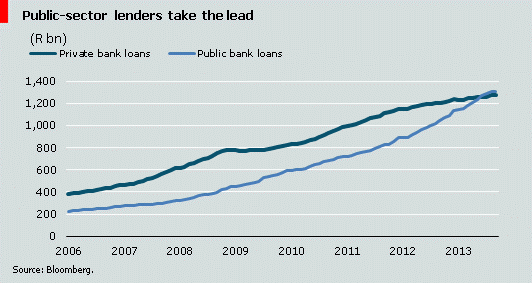
BNDES is lending money at subsidized rates (5.5%). BNDES is now the largest
loan originator in Brazil.
- the daily manipulation of USDBRL to
maintain the currency (via swap) in a tight band before election (in order for
the inflation not to run up further before the poll) – is reducing
external reserves: the swaps are exhausting foreign fx reserves on a net basis
as the central bank is taking huge hit on its short USD exposure created with
the fx swaps
-
historical low industrial production level and deteriorating
-
historical low private sector confidence
A
currency devaluation would increase competitiveness + in parallel leveraging up the
government debt (which would put additional pressure on the FX) to invest in huge projects would help fight inflation on a
structural basis and provide jobs while the economy digest the short term
hangover of the devaluation. Brazil gov probably will need to invest at least
10% of GDP as a one time fiscal stimulus (approx USD 250bn at current rates)-
I expect
a 40-60% devaluation for the BRL over the next 24 months. It could unravel much
quicker as net currency exposures of the Brazilian sector could trigger a snow
ball effect.
I copy/paste
below few charts that illustrate the case - charts Sources: GS, TradeEconomics,
BNDES BSI




Thursday, June 26, 2014
Output Gap, Nominal Rates, Inflation Expectations after banking crisis : 10 years to normalize...on average
An interesting research produced by GS that analyzed the data of banking crisis in 19 countries back to 1800's. Most macro indicators on average normalized after 8-10 years - but if we takes an average of output gap estimates in the US (currently around 4%), we have then more of 3 SD scenario and 10 year yields then could take this time 15 years to normalize! Short bonds anyone ?...;)

Wednesday, June 18, 2014
Small in the news but BIG in potential impact
France and Italy to propose changes to the Stability Pact.
The French and Italian government plan to present changes to the Stability Pact, which defines fiscal rules for Euro area countries, at the upcoming EU summit end of next week. The proposal foresees that government investment to support growth and employment should not be counted anymore for the budget deficit. In return, countries need to make binding promises for structural reforms. While the SPD parts of the German government seem to be in favour of such a change, Chancellor Merkel and finance minister Schäuble are unlikely to approve this proposal. Deputy finance minister Kampeter (CDU), for example, said that the current rules already provided a sufficient degree of flexibility.
This is a very very welcomed and surprising proposal from France and Italy. This is a critical step to reduce Europe s grip on members monetary/fiscal sovereignty which will ultimately allow for more budget deficit needed to kickstart economic growth (pls see article of 2012 for detailed explanations). Someone need to spend!
Wednesday, June 4, 2014
What the ECB should do tomorrow - Key data to follow to trade EU assets
Tomorrow Draghi will speak at the monthly ECB press conference. He promised that he shall use all possible tools to try to defeat deflation in the Eurozone. While there is rumors of negative interest rate and sovereign bonds buying we think that the silver bullet should be something much larger.
Indeed, deflation forces are increasing across the board in the Eurozone :

Lending is anemic at best in the core of Eurozone while negative in the periphery :


To my view, the obvious first medication in the current structural and very large problem is:
Very large quantitative easing with large monthly buying of at least EUR 50bn/month of PRIVATE SECTORS LOANS = corporates loans and asset backed loans. It will restore some velocity in private sector loans, reduce banks balance sheet and reduce yield for loans in the periphery and finally initiate some inflation despite the lack of spending (both on the private sector and government side). While this might appears a"big move" philosophically for the ECB, it will be a small move relative to the deflation/lack of spending in the Eurozone - this is the least the ECB could..
If nothing is done on that front tomorrow, EU markets might not like it and Drgahi might loose some credibility, so it is expected at least some indication of something.
Inflation in the Eurozone is becoming quickly the key risk datapoint to watch for the second part of the year as it will - at one point - be the trigger for QE. It is only a question of time.
Obviously, if tomorrow Draghi offer us a large QE (set up ideally to last until inflation reach a certain level) it will be extremely bullish for equity markets globally.
Indeed, deflation forces are increasing across the board in the Eurozone :
Lending is anemic at best in the core of Eurozone while negative in the periphery :
To my view, the obvious first medication in the current structural and very large problem is:
Very large quantitative easing with large monthly buying of at least EUR 50bn/month of PRIVATE SECTORS LOANS = corporates loans and asset backed loans. It will restore some velocity in private sector loans, reduce banks balance sheet and reduce yield for loans in the periphery and finally initiate some inflation despite the lack of spending (both on the private sector and government side). While this might appears a"big move" philosophically for the ECB, it will be a small move relative to the deflation/lack of spending in the Eurozone - this is the least the ECB could..
If nothing is done on that front tomorrow, EU markets might not like it and Drgahi might loose some credibility, so it is expected at least some indication of something.
Inflation in the Eurozone is becoming quickly the key risk datapoint to watch for the second part of the year as it will - at one point - be the trigger for QE. It is only a question of time.
Obviously, if tomorrow Draghi offer us a large QE (set up ideally to last until inflation reach a certain level) it will be extremely bullish for equity markets globally.
Monday, June 2, 2014
May 26th : raising the probability of a "political bank run"
May 26th European elections saw a strong rise of radical/populist/anti EU parties across the Eurozone which control now approximately 1/3 of the EU parliament. This is a well expected consequence of the static stance of EU political elite in front of raising structural unemployment.
EU parliament seats breakdown. Source: The Economist.

So far, peripheral EU has been impressionably tolerant of historical high unemployment level and economic distress. However, time is playing an increasingly important role in the capacity of the public to digest unemployment and economic hardship. At one point, opposition to EU - which is labeled as the cause of all economic and social illness - may become an evident way to gain broad political ground. We could see Eurosceptisim shifting from radical/populist parties toward a broader part of the Eurozone electoral landscape.
The May 26th vote might have provided us with an open window on the next chapter in the EU crisis. As the Eurogroup is refusing any flexibility into the Maastricht treaty (namely budget deficit and gov debt level) - which could have been implemented for a short period of time and/or adjusted to specific country in financial distress (Greece, Portugal et..) and/or refuse so far to consider Eurobonds - it slowly force Europeans to choose between an Europe with structural unemployment/decimated private sector spending or ultimately a break-up of the Eurozone.
This is quite a risky bet : as time goes by and unemployment stay high, the social forces at play will intensify and at one point it will trigger a snow ball effect: when the Eurosceptisim will be felt as broad enough in term of potential electoral support, it will accelerate significantly as it will resonate into larger political parties = the Political "Bank Run".
The passiveness of the EU political elite in front of the largest eco-social disaster since WWII, might remember to some the passiveness of EU as Hitler was annexing part of east Europe during the Anschluss - we all know how its ended..
Moreover, in a not so distant future as China will continue to rebalance its economy toward domestic consumption, it will be a growing source of demand/import and Germany exports will probably find a new heaven (currently >70% of Germany exports are intra EU) and Eurozone demand will as a result be less strategic for Germany. Therefore, the Eurozone will be significantly less economically attractive even for the most pro-Eurozone member...
% of Populist parties (source: The Economist)

EU parliament seats breakdown. Source: The Economist.
So far, peripheral EU has been impressionably tolerant of historical high unemployment level and economic distress. However, time is playing an increasingly important role in the capacity of the public to digest unemployment and economic hardship. At one point, opposition to EU - which is labeled as the cause of all economic and social illness - may become an evident way to gain broad political ground. We could see Eurosceptisim shifting from radical/populist parties toward a broader part of the Eurozone electoral landscape.
The May 26th vote might have provided us with an open window on the next chapter in the EU crisis. As the Eurogroup is refusing any flexibility into the Maastricht treaty (namely budget deficit and gov debt level) - which could have been implemented for a short period of time and/or adjusted to specific country in financial distress (Greece, Portugal et..) and/or refuse so far to consider Eurobonds - it slowly force Europeans to choose between an Europe with structural unemployment/decimated private sector spending or ultimately a break-up of the Eurozone.
This is quite a risky bet : as time goes by and unemployment stay high, the social forces at play will intensify and at one point it will trigger a snow ball effect: when the Eurosceptisim will be felt as broad enough in term of potential electoral support, it will accelerate significantly as it will resonate into larger political parties = the Political "Bank Run".
The passiveness of the EU political elite in front of the largest eco-social disaster since WWII, might remember to some the passiveness of EU as Hitler was annexing part of east Europe during the Anschluss - we all know how its ended..
Moreover, in a not so distant future as China will continue to rebalance its economy toward domestic consumption, it will be a growing source of demand/import and Germany exports will probably find a new heaven (currently >70% of Germany exports are intra EU) and Eurozone demand will as a result be less strategic for Germany. Therefore, the Eurozone will be significantly less economically attractive even for the most pro-Eurozone member...
% of Populist parties (source: The Economist)
Subscribe to:
Posts (Atom)